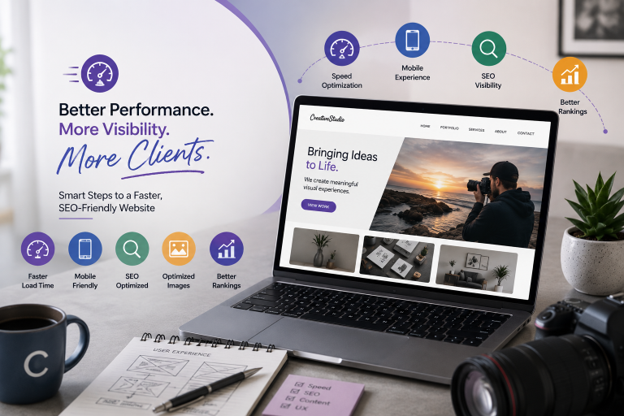
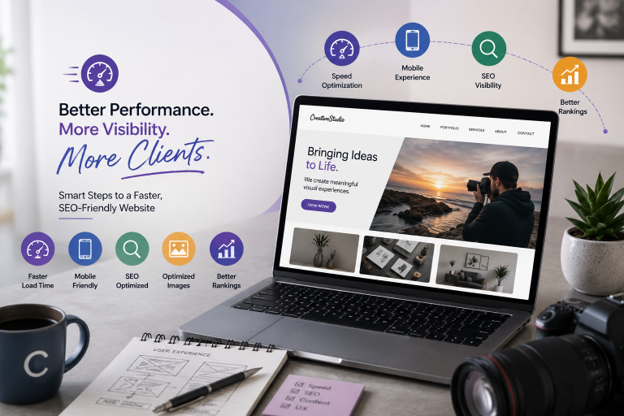
How Creative Businesses Can Improve Website Performance and SEO
Your website is usually the first thing a potential client meets, and for creative work, that first impression counts double. A site that loads slowly or never shows up in search quietly costs you bookings you never even knew were on the table.
Here's the encouraging part: most of what shapes your site's speed and visibility is in your hands. You don't need to be technical, and you don't need to tear everything down and start over. Small, deliberate improvements add up fast.
Below is a practical walk-through of the things that matter most, from load speed and mobile experience to SEO and content structure. Treat it as a working checklist. Wherever your site lives today, these ideas apply.
Why this matters more for creative businesses
Creative sites are visual, and visuals are heavy. Galleries, portfolios, and image-rich pages are exactly what clients come to see, and also exactly what slows a site to a crawl when they're not handled with care.
That's the core tension. The imagery that sells your work can be the same thing that pushes visitors away before it even loads. And since search engines weigh speed and experience when ranking pages, a sluggish site hurts you twice: fewer people find you, and fewer of those who do stick around.
So performance and SEO aren't just technical housekeeping. They're part of how you get found and how curiosity turns into inquiries.
Speed up your website
Speed is the foundation everything else sits on. A few high-impact moves:
● Right-size your images. A gallery photo doesn't need to be print resolution. Compressed, properly sized images in modern formats like WebP can slash load times with no visible drop in quality.
● Turn on lazy loading. Images load as visitors scroll instead of all at once, so your first screen appears quickly even on a heavy page.
● Use a content delivery network. A CDN keeps copies of your site closer to your visitors, so someone across the country loads your work as fast as a local. Check whether your platform includes one.
● Trim the background clutter. Every widget, tracker, and embed adds weight. Audit them now and then, and cut what you no longer use.
None of these are dramatic. Together, they're often the difference between a site that feels instant and one that feels like waiting.
Make sure it works beautifully on mobile
Most of your visitors are on their phones, and clients frequently browse portfolios from bed, on a commute, or between meetings. If your site struggles on a small screen, you lose them.
A few things to check:
● Test on real devices, not just a shrunk-down browser window. Borrow a friend's phone if your own is the only one you ever use.
● Keep tap targets comfortable. Buttons and links should be easy to press without zooming or mis-tapping.
● Watch your galleries on mobile. Image grids that look elegant on desktop can turn into an endless scroll on a phone. Make sure they load and swipe smoothly.
● Confirm text stays readable without pinching, and that nothing important hides off-screen.
Mobile isn't a secondary version of your site anymore. For most creative businesses, it's the main one.
Smooth out the experience and navigation
Once someone lands on your site, they should never have to think about how to find what they want. Good navigation is invisible; bad navigation is the reason people leave.
Keep it simple and human:
● Limit your main menu to the handful of things people actually look for: your work, your services, your story, and how to reach you.
● Make your call to action obvious. If the goal is bookings, the booking path should be clear from every page.
● Reduce clicks to key information. Pricing hints, availability, and contact details shouldn't require a scavenger hunt.
● Guide the eye. Clean layouts, generous spacing, and a clear visual hierarchy help visitors move through your site the way you intend.
When navigation feels effortless, people stay longer and reach out more often. That's the whole point.
Optimize your images the right way
For a portfolio business, images are the product, so they deserve special attention beyond just compression.
● Write real alt text for every image. It helps people using screen readers, and it tells search engines what your visuals show, which matters a lot for image search.
● Name your files descriptively. "coastal-wedding-santa-barbara.webp" does more for you than "IMG_4821.jpg."
● Serve the right dimensions. Don't load a 4000-pixel-wide file into a space that displays 800 pixels.
● Balance quality and weight. Your work should look stunning, but a slightly lighter file that loads instantly usually wins more clients than a flawless one that takes five seconds to appear.
Get this right and your images do double duty: they showcase your talent and quietly bring in search traffic.
Nail your on-page SEO
Technical health makes you eligible to rank. On-page SEO is how you actually get there. The basics too many creative sites skip:
● Give every page a clear title and meta description. Write them like an invitation, not a label.
● Use one main heading per page and organize the rest with logical subheadings.
● Include the words your clients actually search, naturally. Someone looking for a "brand photographer in Austin" should find those words where they belong, not stuffed in awkwardly.
● Keep URLs clean and readable, so both visitors and search engines understand each page at a glance.
These small habits, applied consistently, quietly move you up the results over time.
Understand Core Web Vitals in plain terms
Google measures real-world experience through a set of signals called Core Web Vitals. They sound intimidating and really aren't. They come down to three questions:
● Does your main content load quickly?
● Does the page respond right away when someone taps or clicks?
● Does everything stay put as it loads, or do buttons jump around at the worst moment?
You don't need to memorize the technical thresholds. Just aim for a site that feels fast, reacts instantly, and stays visually steady. Free tools like Google's PageSpeed Insights will score you on all three and hand you a specific to-do list. Running it once a month is a good habit.
Structure your content and internal links
How your content is organized affects both how people navigate and how search engines understand your site.
● Group related content logically. A blog, a portfolio, and a services section should each have a clear home.
● Link between your own pages. If a blog post mentions a service you offer, link to it. Internal links help visitors go deeper and help search engines see how your pages relate.
● Use descriptive link text. "See our wedding packages" tells people and search engines far more than "click here."
● Publish content your clients actually search for. Posts answering real questions, how to prepare for a session, what to expect on a shoot day, how to choose a photographer, pull in exactly the audience most likely to book.
Over time, a well-linked library of useful content becomes one of your most reliable marketing channels, and it costs nothing but effort.
Choosing the right platform for your stage
Some of what shapes performance and SEO comes down to the platform your site runs on, and the honest answer is that the best one depends on where your business is right now.
● Early on, when you need to launch quickly with minimal fuss, an all-in-one builder that handles hosting, galleries, and updates for you is often the smart, practical choice. Simplicity has real value when your time is better spent creating.
● As you grow, and search becomes a serious source of leads, some owners want deeper control over technical SEO, custom features, and integrations. That's when a flexible content management system such as WordPress enters the conversation, trading a little more setup for fuller control.
WordPress is one option among several, not a required upgrade. The right platform is the one that fits your current needs, not the one with the longest feature list. If you do reach the point of wanting a custom, performance-focused build, working with a team experienced in WordPress development can make that step smoother and protect the search rankings you've already earned.
Keep it strong as your business grows
Performance isn't a one-time task. It drifts. New galleries, added tools, and years of content all chip away at the speed you started with. A light, regular rhythm keeps things healthy:
● Check your load times every month or two.
● Run a quick Core Web Vitals scan and act on what it flags.
● Clear out anything you've stopped using, from old plugins to dead pages.
● Protect your rankings during any redesign or migration by using proper redirects, so your hard-earned search authority carries over instead of resetting.
Keeping all of this on track takes consistent effort, and it's an area where ongoing WordPress maintenance and support can carry the load for studios that would rather not think about updates, backups, and performance checks every month.
If the upkeep still pulls you away from client work, it can help to bring in dedicated talent. Some studios choose to hire WordPress developers or similar specialists to handle performance and SEO work directly, freeing them to focus on the creative work that grows the business.
Bringing it all together
Strong performance and SEO really come down to a handful of durable habits:
● Serve lean, well-sized images.
● Make the mobile experience effortless.
● Keep navigation simple and intuitive.
● Give every page a clear SEO foundation.
● Watch your Core Web Vitals.
● Publish and link content that answers real client questions.
● Revisit all of it as your site grows.
None of this needs a computer science degree. It needs attention, and a willingness to treat your website as the working asset it is rather than a set-and-forget brochure.
The studios that get found and book steadily are rarely the ones with the flashiest sites. They're the ones whose sites load fast, rank well, and make it easy for the right clients to say yes. That's a goal worth building toward, whatever stage you're at today.